Before even leveraging key moments throughout the year, businesses must first rely on a gift card solution built on solid foundations. The performance of a gift card program can no longer be improvised — it depends on a long-term vision, seamless omnichannel execution, and usage-driven program management.
Gift cards are no longer an opportunistic lever.
For a long time, gift cards were activated on an ad hoc basis, in response to immediate needs: a spike in activity, a holiday season, or a seasonal opportunity. While this opportunistic approach helped generate volume, it is now showing its limits.
In 2026, a high-performing program now views gift cards as:
- a recurring revenue driver, activated year-round,
- a retention tool, capable of generating intentional and repeat visits,
- an entry point into the customer relationship, particularly at first redemption,
- a structuring B2B channel, more predictable and less seasonal than B2C.
This shift in mindset is critical. Gift cards can no longer be approached as a simple commercial offer. They have become a fully fledged program, integrated into the brand’s broader ecosystem.
The decisions made at the program design stage — purchase journey, redemption rules, covered channels, post-purchase experience, and governance — directly determine long-term performance.
A gift card designed solely around a key trading moment mechanically limits its ability to create sustainable value over time.

An omnichannel gift card program is no longer optional.
In 2026, omnichannel is no longer a competitive advantage — it is a prerequisite. Customers expect to be able to purchase, redeem, and check their gift cards seamlessly across channels, whether in-store or online.
An e-gift card that cannot be redeemed in-store or a balance that is difficult to access directly undermines the perceived value of the gift card and limits real usage.
Omnichannel is not just about multiplying touchpoints. It means delivering a continuous customer experience, from the first interaction through to final redemption.
A high-performing program enables brands to:
- purchase and redemption across all channels,
- immediate recognition at checkout, both in-store and online,
- simple and easily accessible balance checks,
- a consistent experience, regardless of the touchpoint.
Otherwise, gift cards become a source of frustration rather than a driver of engagement.
The experience must be designed across the entire lifecycle.
The performance of a gift card program is built across the entire gift card lifecycle:
- Before purchase: offer clarity, ease of choice, immediate understanding of usage.
- During redemption: seamless in-store or online experience, fast processing, no friction.
- After activation: easy balance checks, reassurance, and incentives to drive full redemption.
A poor experience at any of these stages directly impacts brand perception and repeat purchase intent. Conversely, a seamless experience drives intentional visits, incremental spend, and long-term program performance.
B2C and B2B: two approaches, one shared foundation
Today’s gift card market is built on two complementary dynamics:
- B2C, driven by emotion, simplicity, and instant purchase,
- B2B, built around larger volumes, administrative constraints, and high reliability requirements.
B2B is growing, and use cases are becoming more widespread. Gift cards can no longer be managed on an ad hoc or manual basis. Your solution must be able to ensure consistent customer journeys, operational reliability, and clear offer positioning — regardless of channel or target audience.
In 2026, retailers must address both B2C and B2B simultaneously, with differentiated journeys built on a shared infrastructure. This is a key performance driver.
The wallet is emerging as a new anchor point.
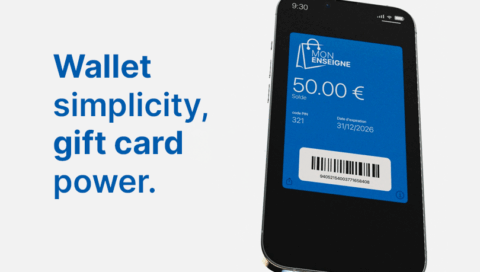
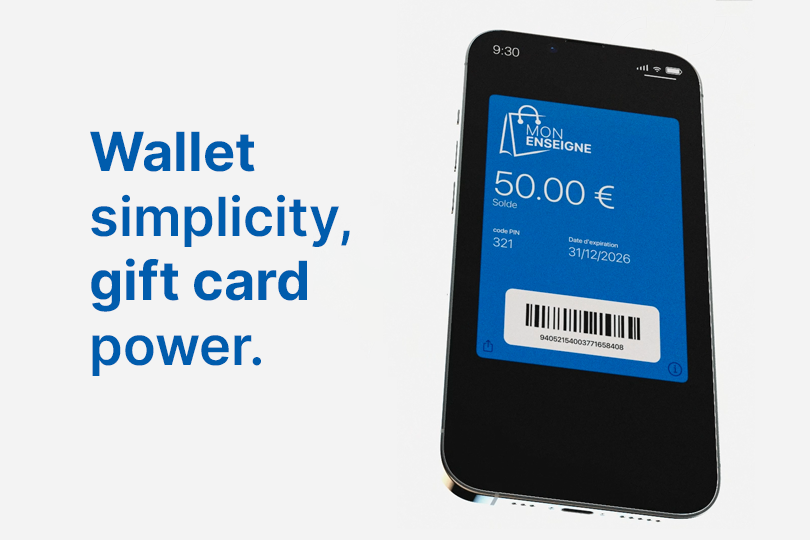
Integrating gift cards into mobile wallets reflects a natural evolution in consumer behavior. Customers now expect simple, instant, and centralized access to their payment methods and digital assets.
The wallet in particular enables:
- centralizing gift cards in a single space,
- making them easier to use in-store,
- reducing forgetfulness and usage friction.
Integrated into the wallet, the gift card gains greater visibility and accessibility without altering the customer journey. It therefore fits more naturally into everyday use and encourages faster, smoother usage.
Performance is driven over time.
Structuring a gift card program means managing it as a fully-fledged business lever. In 2026, performance is no longer measured solely by the volume of cards sold, but by the program’s ability to create value over time.
Beyond sales, certain KPIs provide a more granular view of performance:
- time to redemption, a key indicator of real recipient engagement,
- full redemption rate, reflecting perceived value and experience quality,
- average spend at redemption, measuring the ability to generate incremental spend
These indicators make it possible to move beyond a purely transactional view of the program.

Managing to arbitrate, not just to measure.
Usage analysis enables retailers to:
- adjust proposed denominations,
- optimize purchase and redemption journeys,
- identify the most impactful key moments,
- balance short-term activation with long-term value creation.
A program managed solely through sales remains blind to its real impact on the customer relationship.
Embedding gift cards into a sustainable strategy.
Regular performance monitoring embeds gift cards into a continuous improvement approach. Key moments then stop being isolated campaigns and become true performance accelerators, supporting a structured program.
In 2026, managing gift cards ultimately means managing the usage they generate.